

When you’re living through domestic assault, the world stops feeling safe. Even in your own home, every sound feels louder. Every message feels heavier. And every small moment leaves a mark that no one else sees.
You know what happened. You know the fear, the pattern, the control. But proving it feels like a whole different battle. You might wonder if your phone, or the camera by your door, can finally show the truth. You wonder if your watch was watching. You wonder if the court will believe your watch or fear the evidence won’t be “enough.” We’re here to tell you: it can be.
This guide helps you understand how smart device evidence can support a domestic assault case, especially in Ontario. We’ll walk through what counts, how to protect your digital proof, and how courts look at things like texts, GPS logs, smart-home cameras, and wearable-tech data.
You deserve safety. You deserve to be heard. And your technology might hold the exact evidence that shows what you’ve lived through.
Why Smart Device Evidence Matters in Domestic Assault Cases
In cases of domestic assault, technology often plays a role in documenting abuse. Consider:
- A smart home camera captures an incident of physical abuse
- A wearable tech device recording sudden movement or impact
- Smartphone data showing text threats or location logs
- A GPS tracking device showing a pattern of stalking or coercion
- Social media messages used to intimidate or humiliate
These are real-world examples of digital evidence in Ontario domestic-violence cases. They matter because traditional evidence (like physical bruises or witness statements) may not capture the full picture of technology-facilitated violence (TFV). For victims and defence professionals alike, understanding how such evidence is admitted is crucial.
Key Legal Framework in Ontario
What Counts as Digital or Smart Device Evidence
The federal Canada Evidence Act (CEA) defines an “electronic document” broadly:
“data that is recorded or stored on any medium in or by a computer system or other similar device… includes a display, print-out or other output of that data.”
This covers most of your smart-home monitoring, wearable tech evidence, smartphone data, and GPS tracking device domestic assault evidence scenarios.
Authentication & “Best Evidence” Rules
Under section 31.1 and 31.2 of the CEA:
- s. 31.1: The party seeking to admit the electronic document must prove it is what it claims to be (i.e., authentication).
- s. 31.2: The best evidence rule is satisfied if (a) you prove the integrity of the system that stored the data, or (b) a print-out has been manifestly relied upon, with no evidence to the contrary.
- s. 31.3: There is a presumption of system integrity if certain conditions are met (e.g., system worked properly, or document stored in usual course of business by someone not party to the case).
Importantly, the bar for authentication is low. For instance, as in R v Martin (NLCA) or in the Ontario Court of Appeal, courts describe the threshold as low—there must be some evidence the item is what it purports to be.
Provincial Evidence Act – Ontario
In Ontario, the Evidence Act (Ontario) (RSO 1990, c. E.23) also governs civil/family matters (though criminal proceedings largely fall under federal rules via the CEA).
Common Types of Smart Devices & Digital Evidence in Domestic Assault
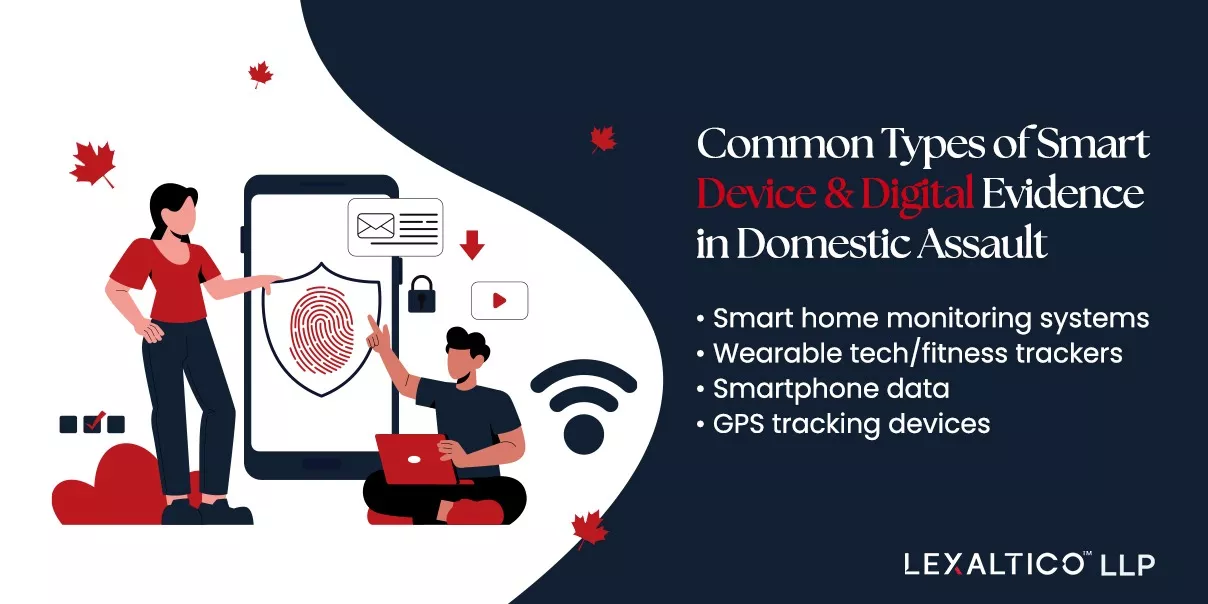
Here are types of tech evidence you might encounter in domestic assault:
| Evidence Type | Description & Relevance |
|---|---|
| Smart home monitoring | Cameras, door sensors capturing intrusion or physical assault. |
| Wearable tech/fitness trackers | Sudden spikes in heart rate, fall detection that match a time. |
| Smartphone data | Texts, calls, apps showing harassment, threats, stalking. |
| GPS tracking device | Location logs showing an alleged perpetrator was present. |
| Social media / direct messages | Threats, harassment, stalking via public/private platforms. |
Let’s dive into each with pro tips for admissibility.
Smart Home Monitoring
Smart home devices (motion sensors, doorbell cams, security cameras) are becoming common. If you believe you have captured a domestic assault event via one of these, here’s how to strengthen the evidence:
- Preserve the original file (video, log) and make a backup.
- Record metadata: camera date/time, device model, settings.
- Ensure the footage was not altered.
- Make a simple note of how you got the footage (who accessed it, when).
This falls under smart home monitoring domestic assault evidence.
Wearable Tech / Fitness Trackers
Wearables can show sudden changes in biometric data or timestamped events like falls. If you think this supports a domestic assault claim:
- Export the raw data (e.g., from the app or cloud).
- Show how the device works (could be via screenshot).
- Link the time of the event to the alleged assault.
This links to wearable tech evidence assault case scenarios.
Smartphone Data (Texts, Calls, Apps)
Your phone often holds key digital evidence: texts, DMs, apps logs. Often you’ll hear “smartphone data domestic violence court”. To strengthen that:
- Take screenshots AND export the conversation (if possible).
- Keep the device safe; avoid altering the evidence.
- Capture metadata: timestamps, sender/receiver IDs.
- Consider screen-recording if app allows.
GPS / Location Tracking Devices
If a tracking device or phone location shows a pattern of harassment or proximity contrary to a protection order, that’s relevant. For GPS tracking device domestic assault evidence:
- Export the logs in a format that shows map data.
- Preserve the device records or app data.
- Cross-check times and locations with events alleged.
Social Media / Direct Messages
Platforms like Instagram, Facebook, WhatsApp can be used to harass or stalk. For social media messages as evidence:
- Capture full threads if possible, not just snippets.
- Include account profile data to show identity.
- Export metadata where you can.
- Be mindful: authentication may be more challenging for lesser-known apps.
Admissibility Checklist: What Courts Look For
When any of the above evidence is used in a domestic assault matter, courts will ask key questions:
- Is the evidence relevant?
- Does it speak directly to the assault or the pattern of abuse/coercion?
- Example: footage shows physical contact.
- Is it authentic?
- Did the party seeking admission show it’s what they say it is?
- Under CEA s. 31.1 the burden lies with the uploader.
- Low threshold: “some evidence” may suffice.
- Does it satisfy the best‐evidence rules?
- Under CEA s. 31.2 print-outs may suffice if they were relied upon.
- System integrity: was the device/medium reliable? (CEA s. 31.3)
- Has the evidence been preserved without tampering?
- Devices should be secured; no editing of critical data.
- Any alteration may raise doubts about authenticity.
- Are there any legal attack-vectors?
- The defence may argue the device was compromised.
- They may challenge metadata, chain of custody, or system reliability.
- Privacy or Charter issues?
- In criminal domestic assault prosecutions, if the evidence was obtained without proper legal process (e.g., warrant), it may be excluded under the Charter or other rules of exclusion.
Technology‐Facilitated Domestic Abuse Evidence: Recognising the Pattern
In many domestic assault cases you won’t just see one event. Instead you’ll see a pattern of behaviour. This is often labelled technology-facilitated violence (TFV) or smart device abuse. Some signs to look for:
- A smart home camera mysteriously “goes offline” each time the accused visits.
- GPS location logs showing repeated proximity despite no legitimate reason.
- Social media direct messages used for threats, harassment, reputation-damage.
- Smart door locks giving repeated, unexplained “entry” logs.
- Text messages that show coercive control (e.g., “I know where you are”).
When you tie this evidence to a pattern, you build a narrative: more than “one assault”, it becomes “abuse sustained over time”. That helps in both criminal and protection-order (civil/family) contexts.
Practical Steps for Victims, Advocates, and Lawyers
When you’re dealing with domestic assault, even small tasks can feel heavy. Sorting through smart-device evidence is hard, especially when you’re still trying to feel safe. These steps are here to support you, not overwhelm you. Take them one at a time. You’re not expected to do everything alone.
Here are simple steps you and your lawyer can use.
- Immediately preserve evidence
Save what you can right away. Export logs, take screenshots, and make backups. Your goal is to freeze the truth before anything disappears. - Avoid altering the device
Try not to delete files or change settings. If the phone or device needs repairs, talk to your lawyer first. A small change can make things harder later. - Document chain of custody
Write down who touched the device, when, and why. Even a simple note in your phone or notebook helps. Courts look for clarity, not perfection. - Get metadata where possible
Metadata shows dates, times, locations, and device details. These tiny details can make your evidence stronger and harder to challenge. - Consider expert advice early
If you have smart-home logs, wearable-tech data, or GPS history, a tech expert can help confirm the accuracy. You don’t need to understand every setting. The right expert can do that for you. - Prepare for disclosure
In criminal cases, the Crown must share the evidence with the defence. They may question how the evidence was collected or stored. In family or civil cases, you may present it yourself. Your lawyer can guide you through each step so you’re not facing this alone. - Understand privacy and legal issues
If the accused installed tracking or spyware without your consent, that is serious. It may lead to additional claims. But remember, even if the method was illegal, the court may still allow the evidence. Your safety and your story still matter. - You’re doing something brave. These steps help protect the truth so your voice is heard clearly and safely.
Bottom Line
Facing domestic assault is painful, confusing, and often isolating. When technology becomes part of that story, it can feel even more overwhelming. But the evidence stored in your phone, smart-home system, or wearable device can also become a powerful way to show what you’ve lived through. It can support your safety, strengthen your case, and help you reclaim control in a situation where so much has been taken from you.
Smart-device evidence doesn’t need to be perfect. It just needs to be preserved, protected, and presented with care. Courts in Ontario are now more open to digital records, metadata, logs, GPS history, and messages. When handled the right way, these small pieces of data can paint a full and honest picture of the abuse that may otherwise stay hidden.
Quick FAQs
Can evidence from smartphones or smart devices be used in domestic assault cases in Ontario?
Yes, courts in Ontario accept smart-device evidence if it is relevant and properly saved.
What types of smart-tech evidence are courts accepting in domestic violence matters?
Courts accept camera footage, door-lock logs, texts, call records, GPS history, smartwatch data, and social-media messages.
How do you authenticate digital evidence from wearables, GPS logs or smart home devices?
You show the court the evidence is real by keeping the original file, saving metadata, and explaining how you got it.
What are the privacy and legal hurdles when using smart home tech data in domestic assault cases?
Privacy rules may limit how the data was collected, and police may need a warrant, but the court can still allow the evidence.
How does technology-facilitated abuse affect domestic assault proceedings?
Tech-based tracking or harassment helps show a deeper pattern of control, which courts take seriously.
Can tracked location or smart-watch data help prove coercive control?
Yes, location logs and body-reaction data can support your story and show repeated control or harm.
What should victims do to preserve digital evidence safely?
Save screenshots, make backups, avoid deleting anything, note who touched the device, and speak to a lawyer or expert first.
Are smart home devices admissible in both criminal and family court in Ontario?
Yes, both court systems allow smart-device evidence when it helps explain what happened.
How might an accused defend against smart-device evidence?
They may claim the device was unreliable, the data was altered, or that it was collected without consent to defend against domestic assault charges.
Disclaimer: The information provided in this blog is for general informational purposes only. For professional assistance and advice, please contact experts.
